To complement the silent Warhol videos, the Swiss Institute played a recording of Erik Satie’s piano piece, “42 Vexations.” I felt a goodly number of vexations while at the Swiss Institute, but fewer than that.
The Swiss Institute is a tiny open gallery space in the ground floor of an old Tribeca building. It’s small and very straightforward, with a little exposed brick and some antique floor tile, but without much floor area to play around with.
Seeing the place, I hypothesized that it was named after a guy, like it’s the gallery of Mike Swiss. However, I’ve confirmed it is the country, not a person. I’m a little puzzled by why the Swiss might want to have a tiny art space in a city replete with them. Is it fiercely neutral? Quixotically democratic? Do they serve great chocolate? None of those things as far as I could tell.
Currently the Swiss Institute is participating in the artist Ugo Rondinone’s multi-gallery birthday present to his husband, “I ♥ John Giorno.” I saw another part of that installation at White Columns a week ago.
Warhol Films Sleep, Induces Same
Here, Rondinone (who is Swiss, so at least there’s some kind of connection) features a series of Andy Warhol videos. Young John Giorno was Warhol’s muse and lover. Projected super-large on the wall in digitized grainy black-and-white is “Sleep” (1963), featuring over five hours of Giorno sleeping. *Yawn.*
Warhol’s “Sleep,” and other videos
Cathode-ray tube monitors around the perimeter of the gallery feature other Warhol videos of Giorno and mutual friends. Two videos show him in the altogether: hanging out (literally) in a hammock and doing the dishes.
I appreciated that they’re showing the videos on CRTs. As at BRIC House, showing video art on the intended screen works way better than trying to put it on a modern, retina display panel.
However, I find Warhol’s videos insanely boring. His screen test close-ups of people just sitting there, his home-movie-style shaky cam videos of his friends goofing around, his naughty videos of naked guys… All of it seems amateurish and tame and lame. Rondinone curating Warhol’s work in the context of his self-indulgent project doesn’t bring anything new to the table. It also doesn’t make it particularly Swiss.
You Can Miss the Swiss
I don’t know who should go to the Swiss Institute. Of course, it might be worth it depending on the content of future shows. But unless they move, they will never have space to show very much of anything. There are many better, bigger, more interesting places to see art in this city. Unless they manage a blockbuster coup of a show (which old Warhol videos of Giorno are definitely not), or start giving away free chocolate, it’s very safe to skip this one.
Seeing an original architectural scale model of the World Trade Center drives home just how huge and boxy those buildings were. I think it’s because today’s supertall skyscrapers are so super skinny, but also I guess I’m slowly forgetting what they looked like on the skyline.
The United States has contributed two distinctively native art forms to the world: jazz and skyscrapers. Both have become global, and both arguably reached their peak in the mid-twentieth century and have gently declined ever since. And both have museums in New York.
The small, scrappy Skyscraper Museum is located in ground floor space in the Ritz Carlton Hotel in Lower Manhattan. Its host building is only 38 stories tall, so not especially impressive by New York skyscraper standards. However, it does have a prominent location when viewing Manhattan from the harbor. Continue reading “Skyscraper Museum”
The Museum has a lovely, quiet, outdoor space called “Garden of Stones,” created by nature artist Andy Goldsworthy. 18 dwarf oak trees growing out of holes in hollowed out boulders, with New York Harbor as the backdrop. It was a deeply welcome spot to spend a few minutes reflecting.
Goldsworthy’s Stones and New York Harbor
“It can’t happen here.”
It’s the refrain of the Museum of Jewish Heritage.
You see it in quotes on the walls and on screens, time and again, from both Jewish and non-Jewish Germans. As the Nazis were coming to power, as rights were being stripped away, as things got worse and worse.
Of course, in retrospect no one really even knew what “it” was, until it was too late. They just clung to the certainty, then the belief, then the hope, that it wouldn’t happen. Because it couldn’t.
The Museum of Jewish Heritage, aka New York’s Holocaust Museum, occupies a lovely plot of land in Battery Park City in Lower Manhattan, right on the Hudson. Shaped like a ziggurat with a low, rectangular addition, the museum opened in 1997, designed by Kevin Roche John Dinkeloo and Associates.
Surprisingly shiny escalator
Its architecture is incredibly carefully thought out. The Core Exhibit spans three hexagonal floors. You move around the perimeter of each floor, then step on a surprisingly shiny escalator to go up to the next one, moving forward in time as you ascend.
The ground floor serves as the prologue, covering Jewish life in Europe in the early 20th century. It touches on topics like holidays, weddings, synagogues, education, and trades, with carefully chosen artifacts showing illustrating those themes. It wraps with four key political strands weaving through Judaism then: socialism, Zionism, liberalism, and orthodoxy.
Then its on to the escalator to Hitler. Worst. Escalator. Ever. The second floor proceeds chronologically, event by event, down a counter-clockwise path toward unspeakable suffering and horror. Small galleries look at (among other things):
The rise of Hitler and Nazi populism.
The story of the St. Louis, an ocean liner full of 900 Jewish refugees that got all the way to Cuba in 1939 only to be turned back to Europe.
Non-Jewish people, like Raoul Wallenberg, Oskar Schindler, and Aristides de Sousa Mendes, who helped rescue Jews.
How the Nazis covered up the Holocaust as they were perpetrating it.
There’s actually less here than I was expecting. Maybe because there’s too much. You can get overwhelmed by scale, lose the trees for the forest. This place is exquisitely careful to make sure you are always aware of the individuals. Every thing, item, photograph is documented to a specific person if they can, with a picture of the individual if they possibly can. Even when it introduces the six main death camps the Nazis used, each comes with a photograph of one person, one actual human being, who was murdered there, who stands for all the rest.
The one part that pushes on scale is a small area with rough wooden walls and flat columns holding photographs of about 2,000 people. Each column has a small booklet, so you can read the names and stories of each of those 2,000 people. It’s not a very big space. The columns go up pretty high. All of them were from France, and all died at Auschwitz.
They had names…
The museum doesn’t bother to observe that to commemorate everyone, all the Jews who were murdered, you’d need 3,000 such spaces. But I thought about that. It does remind you, piercingly, that “They had homes and lives. They had families and friends. They had names.”
The chronology continues, inexorably, through the Nazis’ last-ditch efforts, the liberation of the death camps, and efforts to rescue people and send them home. And somehow live with what happened. And remember.
You ascend once more, another shiny escalator to the post-Holocaust world. Here the story is very much focused on the rise of Israel and the United States as the centers of postwar Jewish culture, and what that culture consists of today, in terms of religious life, the arts, society.
And then, the architects of this place accomplish one of the great feats of New York museum design. I’m not going to give it away. But I got through the core exhibit, walked through the exit doors, and literally had my breath taken away.
Rescued kids
In addition to the Core Exhibit, the Museum of Jewish Heritage currently has a small show called “My Name Is…” of photos of rescued kids who got sent to a variety of centers, with capsule summaries of their stories. This I think was a slight misstep — where the core exhibit works very carefully to go deep and focused, this was a little too broad, with whole lives boiled down to a couple of paragraphs. I think fewer photos with longer stories, and even current pictures of any of the kids who are still alive today, would be better.
The Eichmann Capture Team…
And then I saw “Operation Finale,” a newly opened special exhibition on how the Mossad tracked down and kidnapped Adolph Eichmann, spiriting him from Argentina back to Israel for trial and eventual execution in the 1960s.
This was shockingly entertaining in a place I don’t think of as endeavoring to entertain. A real-life spy story. I’m not 100% sanguine about a country abducting someone in another country, even if that someone was a horrible someone. But better that than simply assassinating him. The recreation of his trial, using several different video projections running in sync, combined with the bulletproof booth Eichmann sat in, worked particularly well.
Eichmann Trial in Projection
In terms of amenities, the Museum of Jewish Heritage has a cafe, although, honestly, what it should have is a shot bar or something. I know I really wanted a drink coming out of the exhibit. It also has the requisite gift shop–if you find yourself needing a mezuzah, their selection is top notch. The museum also boasts a nice, modern auditorium. I’d attended conferences in that space long before I actually went to see the museum itself.
A Little Museum-ology
From a museological perspective, I have a few observations.
Old Screen
The Museum of Jewish Heritage just turned 20 years old, and parts of it need a refit. Some of their video screens have burn-in problems, and others are probably nearing the end of their life expectancy. Some of the photos on display, too, looked like they may not be aging well. I know they’re meant to be old, but still, I think they may require swapping out for fresher prints.
The section on non-Jews who helped — whom Yad Vashem in Isreal recognizes as the “Righteous Among The Nations” needs an update to reflect inductees since this museum opened. That’s a sign that probably other things could use an update, too, since the world has 20 years more Holocaust scholarship on which to draw.
There’s nothing interactive in the Core Exhibit at all. That is certainly for the best. Just brainstorming possibilities in my own mind borderline offends me. So I hope it stays that way.
Video, on the other hand, is critical. There are video screens throughout, and you are never far from someone talking, telling what they saw, what they experienced, relevant to the section or the theme. It’s vital to the museum’s mission of never letting visitors lose sight of real, individual, people.
Never Say Never
I rechecked my time-spent calculations for this visit several times. I still can’t understand how I spent three hours at the Museum of Jewish Heritage. It didn’t feel like it. However, at the same time it was exhausting.
I was talking with a friend about this place just a few days ago and she said “I really, really don’t ever want to go there. Does that make me a bad Jew?” When New York is blessed with museums of so many other, happier things, like maritime industry and Louis Armstrong and lighthouses, mathematics and art and more art, I can’t blame anyone for preferring any other topic to the Holocaust.
But it’s important. It is museum as vaccination. Because it’s all too easy for all of us, everywhere, at all times, to fall into the trap of “It can’t happen here.” It’s good, no, vital, to be reminded that absent vigilance and speaking and acting our consciences, yes, it can.
If you haven’t been to a Holocaust memorial or museum in the past 3 years, you are due for a booster. Go.
I don’t know much about John Giorno’s work, but I’d wear his super-cynical T-shirts.
John Giorno T-Shirt
White Columns has a venerable history, dating to 1970 and claiming to be the oldest “alternative art space” in the city. It’s an art gallery, but I have generally allowed public, not-for-profit galleries on my list, so like A.I.R. Gallery and the Aperture Foundation, I’ll grant it museum status for my purposes. White Columns has moved around a bit during its life, from SoHo to Spring Street to Christopher Street, to its current location in the Meatpacking District. Continue reading “White Columns”
The museum business has always been a tough one. The 1853 Crystal Palace Exposition lost a ton of money. They tried bringing in P. T. Barnum to make it more popular. Even the great showman gave up, though, grumbling, “The dead could not be raised.”
Located in a pretty but unassuming townhouse on West 86th Street, the Bard Graduate Center Gallery offers a couple of floors converted into spaces for, it seems, whatever Bard Graduate Center folks happen to be working on. Bard exhibits come in three flavors: focus projects, traveling exhibits, and artists-in-residence.
The two shows on the day I went were both “focus projects.” Bard Graduate Center defines these as “small-scale academically rigorous exhibitions and publications that are developed and executed by Bard Graduate Center faculty and postdoctoral fellows in collaboration with students in our MA and PhD programs.” (Bard website; longer description here.)
Design by the Book
“Design by the Book” discusses the Sanli tu, a Chinese text from 961 meant to help reconstruct important ritual objects from even longer ago. Confucian China was full of rites and rituals, requiring very specific objects to complete. However, as dynasties waxed and waned, the nature of those objects was sometimes lost. In the mid-900s, a scholar named Nie Chongyi studied ancient writings about these objects, and set out to formally describe and picture them.
It was a good idea, and for a while an influential book. However, what we’d think of as archaeology eventually disproved many of Nie’s ideas when people dug up ruins and found actual examples of the ritual items in question.
The show introduced these ideas via a quick run-down of Confucianism and a look at a copy of the Sanli tu itself. It then showed examples of the kinds of objects it described, like bronze bells, cups, and ceremonial robes. It also included an interactive element inviting visitors to sketch three objects based on their written descriptions. It shows how your artwork compares with Nie’s conception and previous visitors’ attempts. Anyone up for Confucian Pictionary?
New York Crystal Palace 1853
The Crystal Palace show tells the story of the first World’s Fair in the United States, and the tremendous glass and steel building constructed to house it — an epitome of high technology of the time. It’s a bit of a jumble, trying to pack a lot of things into a space too small for it. Somewhat like the Crystal Palace Exposition itself, I suppose. The show defines world’s fairs and outlines the 19th century vogue for them. It describes the Crystal Palace itself and the myriads of exhibits and displays of art, science, and technology that existed within. Guns! Hats! Sculpture! Furniture! Vases! Not much of it to my taste, but they ate it up in 19th century New York.
For a small show, it surprisingly offered not one but three audio tour options: one featuring recorded quotations from Walt Whitman, the other two from imagined perspectives of fictional fairgoers. I’m not so sanguine about the fictional accounts. Plenty of actual people, famous and not famous, visited the Crystal Palace and wrote about their experiences. For instance, the show includes a wall-text quote from a teenage Sam Clemens, who called it “a perfect fairy palace, beautiful beyond description.” It feels like the group that put this exhibit together couldn’t find the contemporary perspectives they wanted, so decided to just make some up.
Better, the exhibit also featured a touchscreen panorama of the fair, enabling a visitor to pan around and zoom in on the cavalcade of wonders.
Crystal Palace Shard
It even had a shard of the Crystal Palace itself. Following the fire that destroyed the amazing building in 1858, bits of glass served as souvenirs.
Overall, I liked this show. Given my obsession with museums, museum shows about museums very much appeal to me (see my review of the Bernard Museum‘s meta-exhibit). But they did have more story they wanted to tell than Bard Graduate Center had space to contain it.
Other Things to Know
Bard’s spaces are indeed pretty tiny. Each show occupied the footprint of the front room and hallway of a floor of the townhouse. It maximizes wall space by blocking windows (at the cost of creating gloomy rooms).
Small installations of contemporary art accompanied both shows in the “back room” space: a video piece about a hunt for a mysterious book in New York for the Crystal Palace, and a performance+light installation for the Design by the Book show. In theory I think having an art piece that riffs on the ideas in the adjoining exhibit can be illuminating. However, given Bard’s lack of space, I would’ve preferred to see more depth from the exhibits themselves.
The Bottom Line
I like the eclectic programming of the Bard Graduate Center Gallery. Lack of a topical mission or a focus can be a negative. But they seem focused on telling unexpected, interesting stories. That stretch of the Upper West Side is an art museum desert, so I like knowing it is there. If you’re going to Zabar’s, or happen to be across Central Park on Museum Mile, consider making a quick detour.
McKim Mead and White’s Castle Garden Aquarium looks spectacular, all heavy romanesque arches and wrought iron barriers to keep the penguins and what-not in. In my dreams of alternative New Yorks where lost architecture survives, I wonder what that building would be today.
Named for New York mayor DeWitt Clinton, Castle Clinton dates to 1811. It was an important fortification built on an island just off of Manhattan. It wasn’t the first defensive installation built to protect Lower Manhattan, and has nothing to do with the older fort that guarded Niew Amsterdam back in the day, which is long gone.
1695 Manhattan map, way before Castle Clinton
However, the fort was part of the network of five state of the art harbor defenses built in the youth of the United States. Although never used in war, merely by existing Castle Clinton and its fellow fortifications around the city helped deter British attacks on New York during the War of 1812. So that’s good. They sacked D.C. instead. Continue reading “Castle Clinton National Monument”
John Rainolds, president of Corpus Christi College, Oxford, suggested the idea of an English Bible to King James. The King James Bible, published in 1611, is maybe the most important book in English.
Yeshiva’s Oxford show has one of only four surviving notebooks from the committee that fretted and deliberated over the translation, responsible for its majestic, enduring poetry. Who says nothing good ever comes from committees?
William Fulman copy of John Bois’s notes on the King James Bible, 17th C.
The Center for Jewish History comprises five institutions under a single, Greek Revival, roof:
American Jewish Historical Society
American Sephardi Federation
Leo Baeck Institute
Yeshiva University Museum
YIVO Institute for Jewish Research
It’s like a food hall for Jewish culture and history. Kosher food hall, anyway.
Accordingly, at any given time the exhibits going on there will be diverse. And there are a lot of them, spread across two floors of assorted spaces of differing sizes, shapes, and capacities, all arranged around a central atrium. During my visit I saw:
A tremendous show of rare books on loan from Oxford’s Corpus Christi College.
The work of George Salter, midcentury book designer extraordinaire
Impressions of Jerusalem in pictures, video, sculpture, and words
A brief overview of the German origins of Zionism in the early twentieth century.
The story of a Portuguese diplomat who defied his superiors and eventually lost his job in his effort to give exit visas to as many people fleeing the Nazis as possible.
A group show of art by current students at Abby Belkin Stern College.
Dusty Old Books
The rare book show, billed as “Five Hundred Years of Treasures from Oxford,” blew me away. According to the wall text, many of the books on view have never left Corpus Christi College before. I can’t imagine the relationship that led to this exhibit happening. The title misleads, though: although it’s Corpus Christi’s 500th anniversary, several of the works on display are way older than that. Indeed, at least two date to the tenth century. I mean seriously. Here there be books over a thousand years old.
St. Basil the Great, “Commentary on the Psalms & Other Works,” 10th Century(!), Greek manuscript
Jewish-Adjacent Programming
I found it particularly interesting that although the show had a Hebrew section, it wasn’t really, well, super-Jewish. I mean, who would expect Corpus Christi to come to Yeshiva. However, in the college’s early days, its founder emphasized the “new learning” of reading holy books in their original languages –so Hebrew and Greek alongside the more usual Latin.
But it’s not purely Biblical, either. The show also features a copy of the Iliad, and numerous significant scientific works. In terms of Hebrew, it featured some beautiful examples of dual Hebrew/Latin manuscripts. It also had a book of Jewish daily prayers, written in Arabic but using the Hebrew alphabet, that somehow made its way to England before the 1200s.
On the science front, they had a copy of Vesalius’s Anatomy from 1555. It’s amazingly important, the first medical book based on contemporary dissections, not just received wisdom from the Classical world. And even better were the tons of annotations from some harried medical student. I love margin notes. Even if I can’t read them, I can empathize with this long-gone person striving to learn and absorb all this new, revolutionary knowledge. Try doing that on an eReader.
Andreas Vesalius, “De Humani Corporis Fabrica,” printed in Basel, 1555.
While a small show, it went incredibly deep. If it was at the Morgan, I reckon there would be a line to see it. It was hard to tear myself away to check out the rest of the Center for Jewish History exhibits. But tear I did, eventually.
More Books!
Atlas Shrugged, Salter Designed
The George Salter show was fascinating, too. Once you see some examples of his work, you realize that he did tons of midcentury classics. And while you can’t judge a book by its cover, his distinctive way with typography and design must’ve helped sell at least some copies of the books he worked on.
The show speaks to Salter’s philosophy of design, from pure typographical covers to ones, like Atlas Shrugged, that capture some resonant idea of the book in simplified, graphical form.
Other Things at the Center for Jewish History
The Jerusalem show provided glimpses and views of the city by a whole variety of artists and writers. It included a tremendous, handmade model of old Jerusalem.
Moses Kernoosh, “Model of Jerusalem,” ca 1880. Wood, cardboard, tin, wire, paint, rice paper
As with the Oxford show, I found it interesting (and welcome) that the perspectives on the city weren’t purely Jewish ones. Mark Twain gets a quote, as does grumpy Herman Melville, who had much to say on the quantity and quality of the stones of Judea. But my favorite quote came from a poem by Yehuda Amichai, “Jerusalem is a Port City,” where he builds an amazing metaphor. I’ll just quote the first and last lines here:
Jerusalem is a port city on the shore of the ages of ages./Jerusalem is the Venice of God.
The student art show was a student art show. A couple of clever things, a couple not-so-clever. And “Portugal the Last Hope: Sousa-Mendes’ Visas for Freedom” and “Zionismus: The German Roots of Zionism” shows both had interesting things to teach, though both went heavy on wall texts and quotes, lighter on art and artifacts.
The Bottom Line
With its diverse institutions all pursuing their different missions, the exhibits the Center for Jewish History cumulatively deliver a comprehensive and diverse look at Jewish concerns and interests. The Jewish Museum, by contrast, has a more narrowly artistic focus. Which absolutely isn’t a bad thing, and puts it on equal footing with many of the other specific-culture-focused institutions in the city. But I got more out of visiting the Center for Jewish History.
If the Yeshiva Museum does even one show every couple of years as deep as the Oxford Library show, I really need to make it part of my regular museum rotation.
Whatever your interests, it’s likely that something on view at the Center for Jewish History will align. Woe unto you if your interests are diverse, you’ll likely spend more time there than you intended. I mean, woe in a good way, of course. Seeing and learning more than you expected must count as among the best of all possible woes.
Studio Job, “Chartres,” 2009-2012, Bronze, 24K gold leaf
This is the best, or at least weirdest, cabinet I have ever seen. Probably the most Gothic. And the least practical. An entire cathedral, tipped on its side! No putting that against the wall, that’s for sure.
UPDATE APRIL 2021: The Met has pulled the plug on its Breuer experiment, reducing its New York City empire to the classic mothership and The Cloisters. I liked what it was doing in the Breuer building, but the silver lining is the Frick is now playing in that space.
Art Fortress
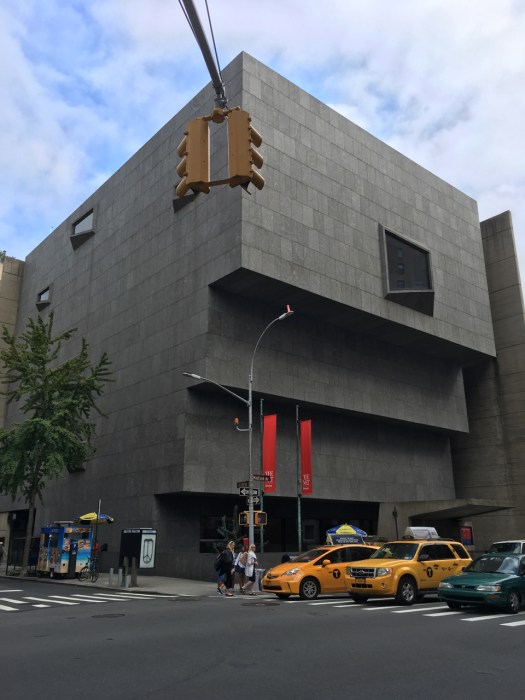
The first thing you should know about my take on the Met Breuer, housed in the former home of the Whitney Museum of American Art, is I really really really dislike the building. The iconic, Brutalist, Marcel Breuer art fortress says to me very loudly and in no uncertain terms, “Don’t come in here. You are not welcome.” It looms over the sidewalk. It has one big wonky window like Polyphemus’s eye. That’s it. It’s a Cyclopean building. A monster. Hide under a sheepskin on your way out or it’ll devour you.
You have to cross a narrow bridge over a crevasse to get in, upping the feeling of peril. Then once you’re in the lobby, the harsh concrete and spotlight-y lights feel like some kind of an art world police state, with you as the object of interrogation. “Admit it! Talk! You like MONET. Confess and maybe we’ll go easy on ya.”
One of the reasons I love the Whitney so much today is simply that it’s no longer in this building.
So, I have a bias.
The second thing you should know is, according to the Met, the architect’s name is pronounced BROY-er, not brewer. Just in case you wondered.
With the Whitney’s move to the Meatpacking District, naturally questions arose as to what to do with the Madison Avenue fortress. Fortunately (maybe?) the Met stepped in and leased it, making it the Met’s second satellite location after The Cloisters. Otherwise they probably would’ve turned it into an H&M or a fancy food hall or something.
Thus far, the Met has used the Breuer building to…well, to let its institutional hair down a bit, it seems. None of the permanent collection has moved. Rather, it leverages the space for special exhibitions. They tend to the modern or contemporary, which is good given the space. And yet, the Met’s also done some fairly fascinating surveys, leveraging the strength of its encyclopedic collection but doing things they might not want to do, or even be able to do, in any of the spaces in the mother ship on Fifth Avenue.
When I visited, one show consisted of four video installations, which were okay. Certainly video works well in the cavelike Breuer space.
Ettore Sottsass, Design Maverick
The other show, on the designer Ettore Sottsass, exemplifies what I mean about letting the Met go a little bonkers installation-wise.
Sottsass first found fame designing an iconic Olivetti portable manual typewriter, in super-sexy lipstick red, with a case that could double as a waste-paper basket. It’s adorable and brilliant, and the Met shows it off alongside other modern designs meant to be cheap and cheerful, like a One Laptop Per Child laptop.
But on top of that, they introduce it with a…colorful quote from Sottsass. I have been visiting the Met for over 20 years, and I really don’t think I’ve ever seen that word in a wall text there before, much less in big type as a key quote.
Sottsass, a man of strong opinions
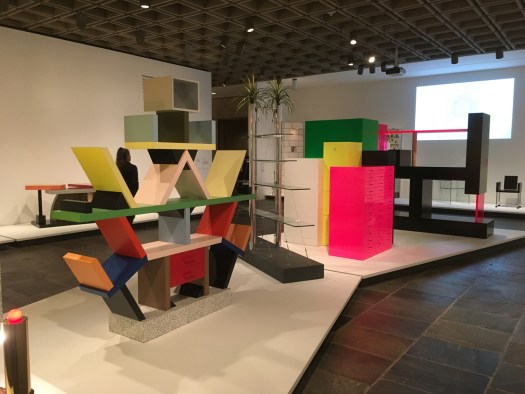
Sottsass had a long career designing things of all types, including the outdoor furniture that uses classical capitals and columns in the photo above. This also provides a typical view of Met Breuer gallery space, with its slate floors and the waffle iron ceiling.
Ettore Sottsass also went on to found the short-lived, exuberant, 1980s “Memphis” design movement, exemplified by his wacky, colorful room divider here.
Creativity Unleashed
Cleverly, the Met juxtaposed some chunky Memphis jewelry with 4,000 year old Egyptian pieces (that looked really good by comparison). They did things like that throughout. Sottsass designed some glass art pieces he called “Kachinas,” and the Met displayed them next to Hopi dolls from its collection. They displayed some of Sotsass’s nifty, colorful, tall, ceramic towers with a Frank Lloyd Wright architectural model, some Shiva Lingam, and a Chinese jade Neolithic ritual object. Throughout the show, these sorts of unexpected pairings helped illuminate Sottsass’s work, providing a look at objects that might have inspired him, or at least creating a novel context for his pieces. I really enjoyed it.
Creative combinations of works in a dialogue across thousands of years and diverse cultures is something places like the Brooklyn Museum have been trying for some time, not always successfully. The Met seems to be using the Breuer to experiment with that approach to curating a show. And I think they’re doing it really well so far.
My Bottom Line on the Met Breuer
So what’s my bottom line on the Met Breuer? I’m not going to say everyone should drop everything and go. The building might be interesting, but I still don’t think it’s a welcoming or pleasant place to see art. But I can’t deny the creativity that’s going into the Met’s programming at the Met Breuer. The staff has done some tremendous shows there so far, full of…spirit. If having the Breuer lets them think about their collection in novel ways, and tell new stories about art, I value that highly. Hopefully some of the Met Breuer spirit will eventually find outlets in the Fifth Avenue HQ, too.
For Reference:
Address
945 Madison Avenue, (at East 75th Street) Manhattan
Poncar’s best photos capture amazing contrasts, both of light and shadow and of the greens in the valleys and the stark surrounding cliffs.
Jaroslav Poncar, “Teri Samdrub Chodhing Gompa,” 2015
Tibet House is the Tibetan Cultural Center, founded in 1987 at the behest of His Holiness the Dalai Lama. Thus it celebrates its 30th birthday this year.
Hello, Dalai
Tibet House hosts an array of classes and events, meditation training, retreats in the Catskills, that sort of thing. It’s kind of a starry place: in addition to His Holiness, Professor Robert Thurman, who teaches at Columbia, is the president of their board, and Philip Glass is vice president. It name-drops a whole bunch of other notables in its acknowledgements of “in-kind” donations: David Bowie, Patti Smith, Christo, David Byrne, Emmylou Harris… Continue reading “Tibet House Gallery”
From a 2007 exhibit on Jewish cemeteries, I learned that they are sometimes called Beit Hayyim in Hebrew, House of Life. More than just a euphemism, it affirms ties between the living and the dead, and an eternal existence to come.
Hans D. Beyer, “Interior of the Schmidl Family Vault,” Budapest, Hungary, 2006
I loved this photograph of the Schmidl family vault in Budapest. An art nouveau extravaganza from 1904, covered in mosaics, I’d like to see it in person someday.
Temple Emanu-El is a beautiful, imposing synagogue, one of several great houses of worship on the green stretch of Fifth Avenue opposite Central Park. The temple itself is shut tight like a fortress between services, However, if you go around to a side entrance on East 65th Street and ask the guard, you can visit the Herbert & Eileen Bernard Museum, which hosts temporary exhibits on various aspects of Jewish life, faith, and culture.
The museum occupies three smallish rooms on the second floor. A life-sized, somewhat cartoony Golda Meir sculpture currently greets you at the door. She seems nice, though somewhat off-putting, like the Jewish museological equivalent of the fiberglass Ronald McDonalds that help to dissuade me from ever eating chicken mcnuggets. Continue reading “Bernard Museum of Judaica at Temple Emanu-El”


 The Swiss Institute is a tiny open gallery space in the ground floor of an old Tribeca building. It’s small and very straightforward, with a little exposed brick and some antique floor tile, but without much floor area to play around with.


 Seeing an original architectural scale model of the World Trade Center drives home just how huge and boxy those buildings were. I think it’s because today’s supertall skyscrapers are so super skinny, but also I guess I’m slowly forgetting what they looked like on the skyline.
 The small, scrappy Skyscraper Museum is located in ground floor space in the Ritz Carlton Hotel in Lower Manhattan. Its host building is only 38 stories tall, so not especially impressive by New York skyscraper standards. However, it does have a prominent location when viewing Manhattan from the harbor.

 “It can’t happen here.”

 There’s actually less here than I was expecting. Maybe because there’s too much. You can get overwhelmed by scale, lose the trees for the forest. This place is exquisitely careful to make sure you are always aware of the individuals. Every thing, item, photograph is documented to a specific person if they can, with a picture of the individual if they possibly can. Even when it introduces the six main death camps the Nazis used, each comes with a photograph of one person, one actual human being, who was murdered there, who stands for all the rest.


 I don’t know much about John Giorno’s work, but I’d wear his super-cynical T-shirts.

 White Columns has a venerable history, dating to 1970 and claiming to be the oldest “alternative art space” in the city. It’s an art gallery, but I have generally allowed public, not-for-profit galleries on my list, so like
  Located in a pretty but unassuming townhouse on West 86th Street, the Bard Graduate Center Gallery offers a couple of floors converted into spaces for, it seems, whatever Bard Graduate Center folks happen to be working on. Bard exhibits come in three flavors: focus projects, traveling exhibits, and artists-in-residence.
 The Crystal Palace show tells the story of the first World’s Fair in the United States, and the tremendous glass and steel building constructed to house it — an epitome of high technology of the time. It’s a bit of a jumble, trying to pack a lot of things into a space too small for it. Somewhat like the Crystal Palace Exposition itself, I suppose. The show defines world’s fairs and outlines the 19th century vogue for them. It describes the Crystal Palace itself and the myriads of exhibits and displays of art, science, and technology that existed within. Guns! Hats! Sculpture! Furniture! Vases! Not much of it to my taste, but they ate it up in 19th century New York.
 For a small show, it surprisingly offered not one but three audio tour options: one featuring recorded quotations from Walt Whitman, the other two from imagined perspectives of fictional fairgoers. I’m not so sanguine about the fictional accounts. Plenty of actual people, famous and not famous, visited the Crystal Palace and wrote about their experiences. For instance, the show includes a wall-text quote from a teenage Sam Clemens, who called it “a perfect fairy palace, beautiful beyond description.” It feels like the group that put this exhibit together couldn’t find the contemporary perspectives they wanted, so decided to just make some up.


 Named for New York mayor DeWitt Clinton, Castle Clinton dates to 1811. It was an important fortification built on an island just off of Manhattan. It wasn’t the first defensive installation built to protect Lower Manhattan, and has nothing to do with the older fort that guarded Niew Amsterdam back in the day, which is long gone.


 The rare book show, billed as “Five Hundred Years of Treasures from Oxford,” blew me away. According to the wall text, many of the books on view have never left Corpus Christi College before. I can’t imagine the relationship that led to this exhibit happening. The title misleads, though: although it’s Corpus Christi’s 500th anniversary, several of the works on display are way older than that. Indeed, at least two date to the tenth century. I mean seriously. Here there be books over a thousand years old.


 With its diverse institutions all pursuing their different missions, the exhibits the Center for Jewish History cumulatively deliver a comprehensive and diverse look at Jewish concerns and interests. The





 Temple Emanu-El is a beautiful, imposing synagogue, one of several great houses of worship on the green stretch of Fifth Avenue opposite Central Park. The temple itself is shut tight like a fortress between services, However, if you go around to a side entrance on East 65th Street and ask the guard, you can visit the Herbert & Eileen Bernard Museum, which hosts temporary exhibits on various aspects of Jewish life, faith, and culture.