
| Edification value |  |
|---|---|
| Entertainment value |  |
| Should you go? | |
| Time spent | 203 minutes across 2 days. I had a lot I wanted to see. |
| Best thing I saw or learned | On display in “New York at its Core” show is the scrap of paper, literally the back of an envelope, on which Milton Glaser scribbled “I ♥︎NY.” It’s such a quintessential statement it’s hard to imagine someone had to invent it, but Glaser did, in 1977. That little idea changed the way generations of visitors think about this crazy place, and it elegantly expresses a sentiment I feel (almost) every day. |
 The Museum of the City of New York is an absolute treasure. It occupies a really lovely Georgian/Federal-style building at the northern end of Museum Mile on Fifth Avenue. The Museum started out its life in Gracie Mansion, but as its collection and ambitions grew, and its directors wanted it to be more central, a move seemed prudent.
I confess I always assumed the building was legitimately old, though on reflection that doesn’t make sense. Who in the 1800s would build a grand federal style institutional building that far north? The building was started for the museum in 1929, and it was completed in 1932.
 For all that it’s merely fake old, it’s got one of the best staircases of any museum in the city, a super-elegant curve leading up from the ground floor. Nowadays complemented by a terrific light sculpture.
It also claims to have the most exciting stairwell in the city, so it’s definitely got a New Yorker’s flair for self-promotion.
Off the top of my head, other great staircases, if you’re a scalaphile or like making a dramatic entrance, can be found at the Neue Gallerie, the Czech Center, the Frick Collection (but you can’t go on it), the Cooper Hewitt, the Rubin, and of course the grand stairs at the Met (both the outside and inside ones). Come to list them, there are a lot of great staircases in New York City museums. But City of New York’s is still near the top.

I also have to say a word or two about typography. Most museums manage signage and wall descriptions okay, but not great. But it matters. City of New York does its visuals stunningly well. Legible, fun, brash… It makes navigating the museum a pleasure.
The main exhibit on currently is called “New York at its Core,” a look at the full sweep of the city’s history, from the earliest beginnings to the future. It’s extremely well thought out, covering an immense amount of content economically and judiciously. It also makes great use of interactive features. Person-height vertical screens in the middle of the main room feature key historical characters  on a rotating basis. Interact with a character and you get more, potentially much more, about them and their contribution. And it’s not just human characters, you can find out about players like beavers and oysters, too. I’m often skeptical of the value of these kinds of things. Too often they are more sizzle than steak. But this impressed me a lot.

Other exhibits look at the Gilded Age, protests in New York (no small topic), photos of Muslim life in the city, and an in-depth look at the city’s zoning laws on the centennial of the original 1916 law.
Let me underscore that. This museum can make a visually and intellectually interesting show out of the city’s zoning laws.

Then there’s the Stettheimer dollhouse, with its legit modern art. And the cafe (great, by the way, and at the top of the grand staircase).
And the future bit of “New York at its Core” where via touchscreen you can design a building, streetscape or neighborhood and have it rated based on affordability and livability and environmentalism. Neat, fun, and yet again way better implemented than is typical for that sort of technology.
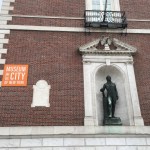 And finally, as I do wherever I can, I will mention Alexander Hamilton, who is present, larger than life size, on the facade.
Should you go? Absolutely. City of New York epitomizes great museuming in my book. It balances edification and entertainment with great finesse, and tells the story of this place such that both newcomers and lifelong New Yorkers can get something fresh and interesting out of it.

For Reference:
| Address | 1220 Fifth Avenue (at 103rd Street), Manhattan |
|---|---|
| Website | mcny.org |
| Cost | General Admission: $18 |


 The National Lighthouse Museum is a museum in its infancy. Located a short stroll from the ferry terminal in St. George, Staten Island, the museum describes the history, technology, and design of lighthouses.


 This incredible 1872 punch bowl and goblets, 36 pieces and 800 ounces worth (that’s 50 pounds! 22.68kg!) of sterling silver. A gift to Isaac Newton Marks, president of the New Orleans Fireman’s Charitable Association. It’s hard to see in the picture but the stem of each goblet is a fire fighter.
 The Fire Museum is like the attic of the New York City Fire Department. It’s where all the old interesting stuff is, and exploring it is very much like sifting through a collection of fire-related artifacts that someone at some point considered worth keeping.
 The Dyckman Farmhouse is the least fancy historic home I’ve been to so far on this project. Owned by the Dyckman family, who had a large farm at the northern tip of Manhattan, the house is reckoned to have been built around 1783, so it’s also the oldest historic house I’ve been to yet.
 It’s totally different from the fancy, symmetrical, Federal style of the other historic houses I’ve seen so far. Rather it is very basic, 2 stories plus a cellar, simple, small, cozy, and a little threadbare. And like all old houses, seemingly quite crowded and uncomfortable back in the day.
 apartment buildings, cars, and buses and putting in rolling fields and outbuildings is hard. There’s a tiny plot of green in back and on the sides of the house, with a reconstructed Hessian hut, but it barely begins to evoke the original agrarian setting.


 The Elevateds were built in the late 1890s and much of the signage was done in beautiful glass with floral decorations. I think of them as just big and hulking, but they must have been rather beautiful as well.
 New York’s main Transit Museum is in Brooklyn, and it is very worth visiting. When they restored Grand Central in the early 2000s, they opened a tiny branch (or “gallery annex”) of the museum there. I’m tempted to say skip it — the exhibit space is very small, it’s more gift shop than museum, and there’s so much else to see at Grand Central.
 This year, the transit system is celebrating the construction of the new Second Avenue Subway. In a brilliant bit of counter-programming, the current show at the Transit Museum’s GCT branch is about a bit of deconstructing, showing photos of the dismantling of the Third Avenue Elevated in 1955.


 Halls of fame today are two-a-penny. Everyone and everything from minor league lacrosse to rock n roll has a hall of fame. But it wasn’t always that way. There had to be, at some point, a first one.
 Visiting Gracie Mansion for this project made me realize I knew nothing about Gracie Mansion, beyond the name.


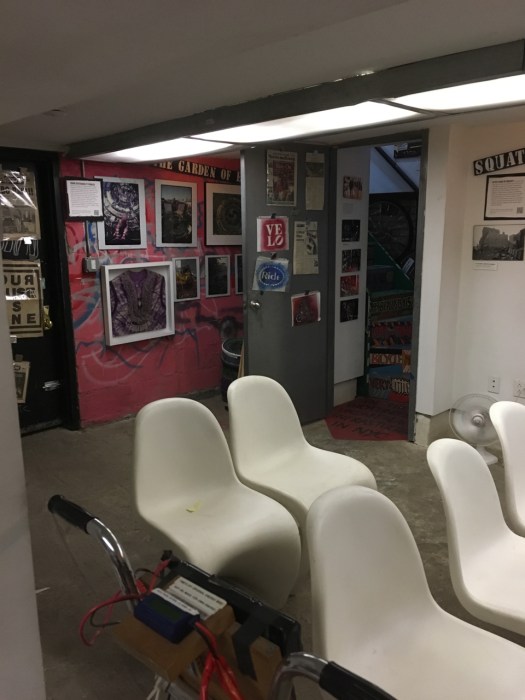 The Museum of Reclaimed Urban Space occupies a classic old-school East Village squat, and consists of some artifacts, photos, and other memorabilia documenting the East Village of the 80s and 90s. It and its denizens focus mainly on squats (abandoned buildings that individuals made habitable and moved into), community gardens, bike lanes, and other aspects of a time and culture that feels increasingly at odds with the hyper-gentrified city of today.