In 1986, the first run of brass subway tokens with steel centers had a tiny “SJD” worked into the design. That stands for “Silvester J. Dubosz,” then Assistant Controller of the New York City Transit Authority. Mr. Dubosz ordered the tokens, and thought it would be cool to have his initials on every one. And he was fired for it. Great relic!
New York City boasts a host of institutions dedicated to preserving our history and heritage, led by the twin titans of the Museum of the City of New York and the New-York Historical Society. I described one of our history museums, the New York City Fire Museum, as the attic of the Fire Department, storing its heritage of historic treasures.
Stretching that metaphor, the quirky City Reliquary would be, not the attic of New York, but the dusty space between the attic floorboards and the downstairs ceiling, where who knows what bits and bobs find their way. Open it up and you may just find a lot of crap, but if you look from the right perspective, treasures abound.
Housed in a tiny storefront in Willamsburg, City Reliquary started as a hobby for its founder, who first created it as a display in a window in his apartment. It has grown from there as New Yorkers with collections of, well, whatever, occupied the space for exhibitions, and the Reliquary’s own collections multiplied.
The current temporary show features perhaps the most under-appreciated of the city’s street foods, the humble knish. I learned things I never thought to wonder about knishes. Where they come from (the Eastern European knish belt extends from Latvia through Moldova); who makes them (there are six “Heroes of the Knish” who are the main local manufacturers); and what it means in Yiddish slang (lady parts). Also, back in 2013 Joan Rivers tweeted that Kim an Kanye should name their baby Knish because “who doesn’t love one?” Who knew?
The restroom at City Reliquary
The rest of the space is crammed from floor to ceiling, and then some, with a dizzying assortment of this-and-that, bric-a-brac, and thingamabobs. Even the restroom threatens a case of sensory overload.
New York geology, including core samples of Manhattan bedrock.
Souvenirs and memorabilia from both the World’s Fairs.
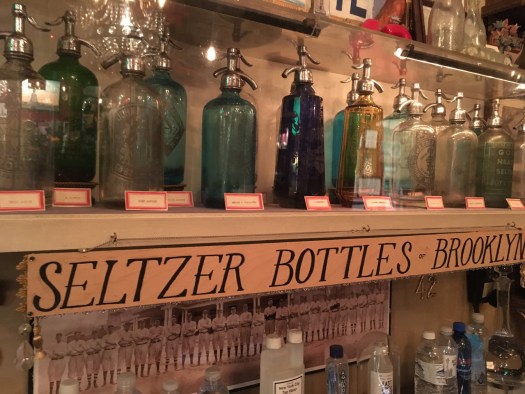
Seltzer and other native soft drinks.
“Little Egypt,” a burlesque dancer.
Jackie Robinson.
A quilt commemorating the Triangle Shirtwaist Fire.
The Reliquary is dense. Every time you visit, you’ll discover something new. Should you go? Those seeking a solid chronological telling of New York’s tale won’t find it there. But those looking for the quirky bits will love this place. Alternately, if you’ve explored the A-list history museums and still feel like something’s…missing, have I got a place for you!
In the end, New Yorkers will probably get more out of it than visitors. But for anyone afraid that this city has become sterile and homogenized and has lost its mojo, the Reliquary has it. It’s in one of their collection of Greek coffee cups, next to some gneiss and schist samples, on a shelf just below the collection of subway grab-holds.
The BBG’s amazing tulip collection was going full-force the day I visited. This time of year always makes me think that the Dutch 17th century tulip-mania wasn’t entirely irrational.
The Brooklyn Botanic Garden (BBG) is one of the two great arboretums (arboreta?) in the city. It’s sibling/rival is the New York Botanic Garden in the Bronx, and there are a number of other botanic gardens of note, to say nothing of the great parks. The Brooklyn Botanic Garden is also a bit problematic for me: it was on the original list of all the museums in NYC, and even back in February I can remember thinking, “but is a botanic garden really a kind of museum?”
At best the answer is “sort of.” I think of botanic gardens as zoos for plants, more than museums of plants. What’s the difference? A zoo and a museum can both be places of edification and entertainment. But I had trouble ranking BBG on the scale I’m using for this project–it didn’t turn out well, not because it’s a bad place, but because the museum yardstick doesn’t really work for it.
The great bits of the BBG are:
The Japanese Hill and Pond Garden
The Shakespeare Garden
The lilac hill
The rose garden (at its best in late spring through summer)
An estimable collection of bonsai
A fantastic cherry collection
The annual Sakura Matsuri, or Japanese Cherry Blossom Festival, is a bonkers mix of cosplay and traditional dance and music. Packed with people but worth it.
Admissions line to the BBG, random spring Saturday
About the only downside of the BBG is that it can be immensely crowded. Not the whole place of course, and not every day. But on a nice weekend day in springtime, the picturesque parts of the gardens are packed with hipsters and others, out for an Instagrammable moment in the sun. To the point where I wonder if it’s really worth paying $15 for an experience you could closely replicate right next door in Prospect Park for free.
I guess that’s my big point of hesitation with any botanic garden: if you’re looking for a quiet tree under which to read a book, or spring blossoms to admire, or a place for a picnic with friends, all those things are available other, freer places, which might even be less crowded than the garden is.
Of course the garden is educational and beautiful.
There are some art pieces by Shayne Dark installed currently (hit or miss, though I do like the faceted steel boulders), and you can definitely learn about going greener, or about desert or rainforest ecosystems in the small greenhouse the BBG maintains. And it has a children’s garden and other educational areas as well.
Whether I’d advise going to the BBG…in some ways, of course. It’s a beautiful place to spend an afternoon outdoors. But I can’t give it an unadulterated, unhesitating “go!” recommendation, on two counts.
First, the aforementioned over-crowdedness. The garden is at its peak of beauty in springtime, but it’s also at its peak of annoyingness. Any other season, on a day with nice weather, I’d say it’s worth it. But in springtime, I’d regretfully advise avoiding it on weekends. Or at least go forewarned.
Second, if you only have time or desire to visit one botanic garden in New York City, go to the New York Botanic Garden in the Bronx instead. It is much bigger, usually less crowded, the greenhouse environments are larger and prettier, and the spring flowers are more spectacular. It can’t match Brooklyn on cherries, but it has a whole hill of crab apples that this time of year are magnificent. It’s got the last patch of old-growth forest inside the city limits. It’s got a waterfall.
So BBG, with its convenience both a blessing and a curse, should be your second botanic garden visit.
For Reference:
Address
990 Washington Avenue, Brooklyn (convenient entrance on Eastern Parkway near the Brooklyn Museum)
Glendora Buell has had a public access TV show, A Chat with Glendora, since 1972. At over 44 years and 11,600 (!) episodes, it’s the longest running public access show. She’s 88 years old. God bless!
Built like a BRIC…um…House.
BRIC House is a flexible arts space including a theater, ballroom, and an exhibition space in an artsy part of downtown Brooklyn (right next door to the Brooklyn Academy of Music’s Harvey Theater).
It took a while to figure out what “BRIC” stands for: Brooklyn Information & Culture. Or, “stood for.” According to their website while that’s where the name comes from, officially it doesn’t stand for anything right now.
Anyway, the organization has been around since 1979 under various names–it started out as the Fund for the Borough of Brooklyn, and so in some alternate universe I suppose I visited FFoBB House instead of BRIC House. In this universe, it only moved into its new space, a shiny refit of the old Strand Theater, in 2013.
BRIC organizes a major free festival every year (Celebrate Brooklyn!) and its BRIC House home base gives it space to put on a whole array of arts programming.
The “museum” space is an airy, high-ceilinged open space that goes down well below street grade but thanks to a large swath of half-height windows is flooded with light. There’s an informal stair-seat space that BRIC uses for talks and lectures, with the gallery space behind it.
The current show, Public Access/Open Networks celebrates public access TV as the original user-generated video form. It includes a piece by Nam June Paik, so you know its arts bona fides are in place, but looks at a variety of public access shows, extending to the modern day with Youtube videos as the new “public access.”
“Public Access is the mother of all social media, the original uncurated social art.”
In addition to Glendora Buell above, one standout was a waffle restaurant that doubled as the studio of a talk show–walk in for waffles and you might be a guest, or possibly even the host. And there’s a taste of how different subcultures and interest groups have used public access to gain a voice, though I might’ve liked a bit more focus on that. Also, no Robin Byrd? No Wayne’s World? I question the curatorial judgment.
Almost better than the content was the array of antique tube monitors they scrounged up to show the video on. It’s been long enough that these bulky, cubical relics are starting to look alien to me. TV was so much better on one of these fuzzy old behemoths, said no one ever.
BRIC House also houses a cafe, so if you’re in need of an upscale coffee, it’s yet another reason to stop in. As with a lot of places, whether you should stop in or not is going to depend on what’s on exhibition. I’m skeptical it’s worth a special trip. It’s more like if you’re going to BRIC for an event, check out the gallery while you’re there. Or if you’re seeing a show nearby, or taking a glassblowing course (Brooklyn Glass is right upstairs), visit for a coffee and some art.
I felt I should pick something from the permanent collection. Having seen several 1800s-era houses so far, I have been wishing there was a historic house museum from the 1920s. I don’t think one exists, but this period room, the 1928-1930 Weil-Worgelt Study, done in glorious art deco, makes that feeling all the stronger.
If you aren’t a local, you’d be forgiven for thinking that the Brooklyn Museum is all about Brooklyn. There is a museum about Brooklyn, but this isn’t it. The Brooklyn Museum is Brooklyn’s answer to the Metropolitan: huge beaux arts building covering the full sweep of art across times and places. It traces its history back to 1824, making it one of the oldest cultural institutions in the city, and the current building was started a couple of years before the 1898 consolidation of the five boroughs into Greater New York City, when New York and Brooklyn were cultural and to some extent economic rivals separated by a small river.
Of course the rivalry is still true of Manhattan and Brooklyn today, but when they were separate cities, having a comprehensive art museum in Brooklyn was a point of civic pride.
Here’s the thing. The Brooklyn Museum can’t compete with the Met. It doesn’t have the resources, it doesn’t have the brand, it doesn’t have the collection. It’s strong in some things– fantastic Egyptian, great Asian, superb American art. But the Met outclasses it mightily. It used to try to compete, though. And did pretty well of it, at least sometimes. But starting a little over a decade ago, Brooklyn decided to change the game, move the goalposts. It would be populist, accessible, earnest, and reach out to its community in a way that the Met, as a global museum that happens to be in New York, maybe can’t do as well.
This has been at best a mixed success. There’s a Columbia Marching Band fight song that mocks Brown students for lax academic standards–the lyrics say that they “take seminars in spider-man/and raisin bran/if it’s pass-fail they’ll take it.” I think of that song when I think of the Brooklyn Museum — it’ll put on exhibits on anything. If it thinks it’ll get a body through the door, it’ll do it. The exhibit on “Star Wars” as art in 2002 –as “Attack of the Clones” was in theaters–permanently reduced its stature in my eyes.
But rather than an exhaustive historical essay on the success or failure of specific populist shows, let’s look at what’s on now. That won’t be directly relevant to your future decision of whether to visit or not, but it will help you understand what to expect. From worst to best:
Iggy Pop: Life Drawings. Some dude named Jeremy Deller had Iggy Pop pose nude for 4 hours in front of a bunch of amateurs. Drawings from that…experiment…are on display along with some pieces Deller selected from Brooklyn’s collection that feature the nude male form. The result is as horrible and sensationalist as I can imagine. You get to see some bad (and, admittedly, a few quite good) drawings of naked Iggy Pop, and a seemingly random assortment of other naked guys. It’s neither edifying nor entertaining, unless you like looking at sketchy renderings of a famous old guy’s junk.
Infinite Blue. The exhibition space on the main floor is devoted to the color blue. Things drawn from the Brooklyn’s collection that happen to be that color. There’s nothing wrong with this idea, but the execution fails. This is an opportunity to juxtapose objects to highlight how different cultures see the color and what it means to them. Instead, pieces are segregated by origin, so that there’s a Hindu corner, an Egyptian vitrine, a Chinese porcelain cabinet, a European sector. Put a 16th C. painting of Mary, with her ubiquitous blue mantle, right next to a blue-skinned Krishna: blue representing purity versus blue symbolizing Krishna’s infinite power via the color of the sky and sea. That’d be thought-provoking. Both those pieces are here, but a visitor has to walk a ways to see them. Quite a few cultures and languages have blurred blue and green together. Why is that? This show won’t tell you.
Unknown artist, “Death Cart,” 1890-1910, Taos, New Mexico
But then there’s Life, Death, and Transformation in the Americas, a small show drawn from the museum’s collection of Native American art, that’s instructive, interesting, and a little macabre. An exhibit after my own heart.
Marilyn Minter, “100 Food Porn,” 1989-1990, enamel on metal
And a great Marilyn Minter retrospective. I sort of knew her but not well. Some of her work is over the top for my tastes, but I hadn’t ever seen her “food porn” series from 1990 (as opposed to her just-plain-porn series) and I found it delicious.
The biggest show on currently is Georgia O’Keeffe: A Living Modern, portraying her more as icon than as artist. It blends some of her paintings with clothes from throughout her life, and photographs of her taken by everyone from Alfred Steiglitz to Cecil Beaton to Karsh to Richard Avedon. It’s fascinating to see how so many different photographers viewed one individual, and how easy it is to tell those with whom O’Keeffe clicked, and those with whom she didn’t. It’s also fascinating to see how carefully she controlled her own image from the start of her career. By her later years, you don’t even need to see her head. Gnarled hands holding an animal’s skull against a black, belted dress lit by harsh desert light communicate exactly whom you are looking at. This is the Brooklyn Museum doing something different, fresh, unexpected, and doing it well.
And then there’s the permanent collection. If you’re an Egypt fan, you have to go just for those galleries alone. Asia was being reinstalled when I visited.
Brooklyn’s Egyptian Collection, all to myself on a Friday afternoon
The Brooklyn has its share of masterpieces, but opted to use the collection differently, as a lens on history and sociology. Who created art and who wanted art and what it expressed about society at the time. The Brooklyn is quite good in that respect, and it gives them a chance to leverage objects that don’t necessarily qualify as top hits. But sometimes you just want to see a great piece of art, and those aren’t always readily on display.
Chauncy Bradley Ives, “Pandora,” 1871
In most other American cities, the Brooklyn Museum would be the must-visit art museum. The Brooklyn has tried earnestly to attract new audiences, which I respect. And it has tried to differentiate in a city that, as my statistics show, is overcrowded with art museums. I respect that too. But in my opinion, it errs in its willingness to entertain at the expense of edifying.
And its efforts have alienated at least some of its core audience –i.e., me. Prior to this visit, I hadn’t gone since a Takashi Murakami show in 2008. It hasn’t done anything to make me want to go. Should you go? Yes. But go knowing that some of the Brooklyn Museum’s efforts at being edgy, innovative, or populist are terrible, and therefore it isn’t as good as it could or should be.
For Reference:
Address
200 Eastern Parkway, Brooklyn
Website
brooklynmuseum.org
Cost
General Admission: $16 suggested donation. Special exhibitions $20 mandatory (includes museum admission)


 Housed in a tiny storefront in Willamsburg, City Reliquary started as a hobby for its founder, who first created it as a display in a window in his apartment. It has grown from there as New Yorkers with collections of, well, whatever, occupied the space for exhibitions, and the Reliquary’s own collections multiplied.
 The current temporary show features perhaps the most under-appreciated of the city’s street foods, the humble knish. I learned things I never thought to wonder about knishes. Where they come from (the Eastern European knish belt extends from Latvia through Moldova); who makes them (there are six “Heroes of the Knish” who are the main local manufacturers); and what it means in Yiddish slang (lady parts). Also, back in 2013 Joan Rivers tweeted that Kim an Kanye should name their baby Knish because “who doesn’t love one?” Who knew?



 The BBG’s amazing tulip collection was going full-force the day I visited. This time of year always makes me think that the Dutch 17th century tulip-mania wasn’t entirely irrational.
 The Brooklyn Botanic Garden (BBG) is one of the two great arboretums (arboreta?) in the city. It’s sibling/rival is the New York Botanic Garden in the Bronx, and there are a number of other botanic gardens of note, to say nothing of the great parks. The Brooklyn Botanic Garden is also a bit problematic for me: it was on the original list of all the museums in NYC, and even back in February I can remember thinking, “but is a botanic garden really a kind of museum?”
 At best the answer is “sort of.” I think of botanic gardens as zoos for plants, more than museums of plants. What’s the difference? A zoo and a museum can both be places of edification and entertainment. But I had trouble ranking BBG on the scale I’m using for this project–it didn’t turn out well, not because it’s a bad place, but because the museum yardstick doesn’t really work for it.
 The annual Sakura Matsuri, or Japanese Cherry Blossom Festival, is a bonkers mix of cosplay and traditional dance and music. Packed with people but worth it.
 Of course the garden is educational and beautiful.


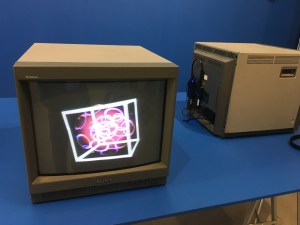 Almost better than the content was the array of antique tube monitors they scrounged up to show the video on. It’s been long enough that these bulky, cubical relics are starting to look alien to me. TV was so much better on one of these fuzzy old behemoths, said no one ever.


 If you aren’t a local, you’d be forgiven for thinking that the Brooklyn Museum is all about Brooklyn. There is

 The biggest show on currently is Georgia O’Keeffe: A Living Modern, portraying her more as icon than as artist. It blends some of her paintings with clothes from throughout her life, and photographs of her taken by everyone from Alfred Steiglitz to Cecil Beaton to Karsh to Richard Avedon. It’s fascinating to see how so many different photographers viewed one individual, and how easy it is to tell those with whom O’Keeffe clicked, and those with whom she didn’t. It’s also fascinating to see how carefully she controlled her own image from the start of her career. By her later years, you don’t even need to see her head. Gnarled hands holding an animal’s skull against a black, belted dress lit by harsh desert light communicate exactly whom you are looking at. This is the Brooklyn Museum doing something different, fresh, unexpected, and doing it well.

 And its efforts have alienated at least some of its core audience –i.e., me. Prior to this visit, I hadn’t gone since a Takashi Murakami show in 2008. It hasn’t done anything to make me want to go. Should you go? Yes. But go knowing that some of the Brooklyn Museum’s efforts at being edgy, innovative, or populist are terrible, and therefore it isn’t as good as it could or should be.