| Edification value |
 |
| Entertainment value |
 |
| Should you go? |
|
| Time spent |
19 minutes |
| Best thing I saw or learned |
A set of embroidered Bodhisattvas and Buddhas, inspired by statues in a particular grotto. Spectacular and almost three-dimensional even though they’re flat pieces of textile |
 Yesterday was both International Women’s Day and the start of Asia week and so it was appropriate (though if I’m being honest, unplanned) that I celebrated by going to the Korean Cultural Center to see a small show on the life and art of Young Yang Chung, a contemporary female Korean embroiderer.
The Korean Cultural Center has a small space for art tucked away on the eighth floor of an anonymous office building on Park Avenue in Midtown. Still, it’s well appointed and well lit and good for a small-scale show like this one.
It was interesting to me that Dr. Young does both very contemporary-looking pieces and much more traditional ones as well. Her large screens with deer and flowers and fish and such are impressive technically and in terms of the time it must’ve taken to make them. But I was much more partial to her more experimental, contemporary pieces. In addition to the Buddhas I mention as the “best thing I saw,” the show included a series on Venice that consisted of pieced fabric and quilting and embroidery that were just beautiful, and a fairly adorable frog based on a Japanese woodblock print by Kitagawa Utamaro.
The larger point of the show is that embroidery was always considered “women’s work” and not really “art,” and people like Dr. Young have done much to show that there’s high aesthetic and artistic value in it, and it shouldn’t be overlooked. It’s a good example that you don’t need a big show, or a large exhibition space, to say something interesting and important.
Should you go? I liked the space. If “The Movement of Herstory” is a good example of how well they curate it, I’d definitely recommend checking out future shows there.
Reference: The Korean Cultural Center


 I’m not sure why the Korea Society has a gallery space, but I have two theories.


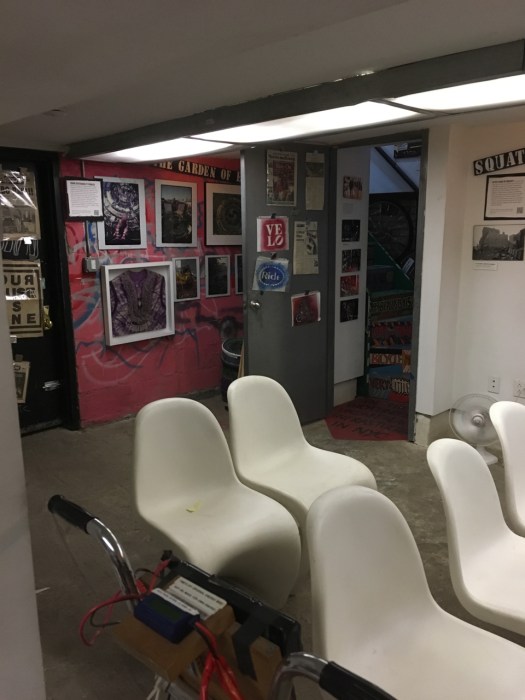 The Museum of Reclaimed Urban Space occupies a classic old-school East Village squat, and consists of some artifacts, photos, and other memorabilia documenting the East Village of the 80s and 90s. It and its denizens focus mainly on squats (abandoned buildings that individuals made habitable and moved into), community gardens, bike lanes, and other aspects of a time and culture that feels increasingly at odds with the hyper-gentrified city of today.
  Marko Shuhan’s 2016 work “Space Needed, Apply Within,” a crazy hodgepodge of paintings and paints and liquor bottles on shelves. Like an artist’s studio compressed into a single wall installation.
  The Ukrainian Museum is one that I definitely wouldn’t go to barring this project. It occupies a sort of blah, to be honest, modern building on a side street off Cooper Square, and has moderate gallery space with temporary exhibits.
 “Let us have peace.” So reads the inscription on the last resting place of America’s greatest military hero of the 19th century.
 At one point, Grant’s Tomb was the most visited tourist destination in New York City. And to this day it is the largest tomb in North America. Built when the city didn’t extend that far north, it was a prominent marble landmark on a hill, attracting visitors in droves, by boat and train, coach and bus, to pay their respects.
  Hamilton placed a marble bust of himself styled as a slightly smirking, handsome, Roman senator, in the entryway of the Grange. Looking at it now it’s like he’s thinking, “Hey, Jefferson, you may get to be president, but see if anyone composes the biggest musical in Broadway history about YOU someday.”